Can I Afford to Buy in Saskatoon? A Small House vs a Condo
If you're renting in Saskatoon and have quietly decided buying is out of reach, you're not alone. But a lot of the time, people are closer than they think.
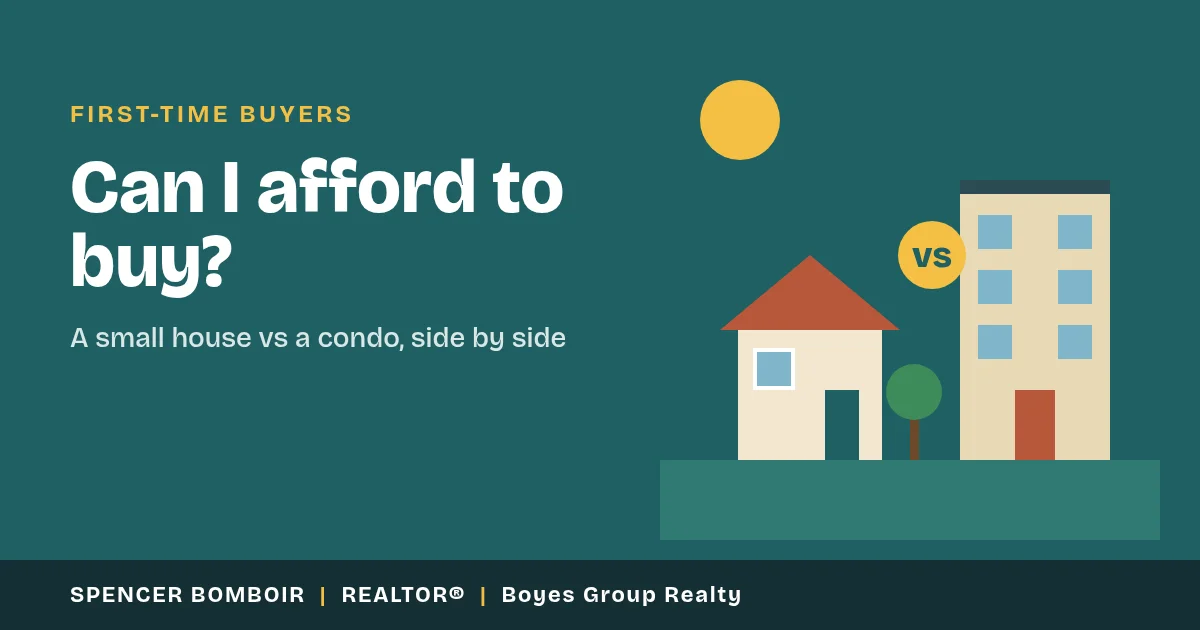
Below, we compare a small house and a condo side by side, with the same assumptions, so you can see what each one really costs.
Want to skip ahead and plug in your own numbers? Try our "Can I afford to buy?" calculator.
First, what you're paying now
The average asking rent in Saskatoon was about $1,340 a month for a one-bedroom and $1,620 for a two-bedroom in the second quarter of 2026, according to Statistics Canada. Add power, internet and tenant insurance, and a lot of renters are spending somewhere around $1,500 to $1,800 a month on housing.
Keep that number in mind. It's the one to beat.
The two homes we're comparing
To keep it realistic, we picked prices you can actually find in Saskatoon right now:
- A condo at $250,000. Think a one or two-bedroom unit in an established building. The Saskatchewan REALTORS® Association put Saskatoon's benchmark condo price around $264,500 this spring, so this is right around a typical condo.
- A small house at $350,000. Think an older bungalow or a smaller 1.5 storey in a mature neighbourhood. Saskatoon's benchmark price for a detached home was around $501,000 this spring, so this is a starter house, not an average one. Homes like this come up regularly in established neighbourhoods like Sutherland, Avalon and Exhibition.
Both examples use 5% down (the minimum for a home under $500,000), a 4.5% five-year fixed rate and a 30-year mortgage, with mortgage insurance added. The best insured five-year fixed rates were around 4.4% to 4.6% in early November 2026.
Small house vs condo: the monthly cost
| Condo $250,000 | Small house $350,000 | |
|---|---|---|
| The purchase | ||
| Purchase price | $250,000 | $350,000 |
| Down payment (5%) | $12,500 | $17,500 |
| Mortgage, including insurance | $247,475 | $346,465 |
| Every month | ||
| Mortgage payment | $1,248 | $1,747 |
| Property tax | $260 | $365 |
| Condo fees | $375 | $0 |
| Utilities (power, heat, water, internet) | $120 | $325 |
| Home insurance | $35 | $110 |
| Repairs and maintenance (set aside) | $40 | $150 |
| Total monthly cost | about $2,080 | about $2,700 |
| Getting in the door | ||
| Cash needed at closing (down payment plus costs) | about $16,300 | about $22,000 |
| Household income to qualify (no other debts) | about $61,500 | about $81,800 |
Estimates only, as of November 2026. Condo fees vary a lot from building to building, and what they include does too. Utilities, taxes and insurance depend on the home. Income to qualify uses the mortgage stress test and standard lender limits, and goes up if you have a car loan, student loan or credit card payments.
What the table is really telling you
The condo is closer to rent than you might think
At about $2,080 a month, the condo costs a few hundred dollars more than a typical two-bedroom rental once you add up rent, power and tenant insurance. But a few hundred dollars of every mortgage payment goes toward paying down your own home, and that amount grows every year. Rent doesn't do that.
The condo fees also cover a lot. In most buildings they pay for the roof, the outside of the building, snow removal, landscaping and building insurance, and sometimes heat and water too. That's why the utilities and repair lines are so much lower on the condo side. Before you buy, it's worth checking the building's reserve fund. A healthy one means fewer surprise bills later.
The house costs more, but you get more
The small house comes out about $620 a month higher. No condo fees helps, but you're paying for your own heat, your own insurance and your own repairs. We set aside $150 a month for repairs, because furnaces, roofs and water heaters don't care about your budget. Some years you'll spend less, and some years more.
In return, you get a yard, no shared walls, no condo board and more freedom to renovate.
The income question
To qualify, lenders use a stress test. You have to qualify at the higher of 5.25% or your actual rate plus 2%. With a 4.5% rate, that means qualifying at 6.5%.
Even with the stress test, a household earning around $61,500 with no other debts could qualify for the condo in our example. Around $82,000 could qualify for the small house. If you're buying with a partner, that's combined income, which puts both well within reach for a lot of couples. Buying on your own? The condo, or a house closer to $300,000, may be a more comfortable place to start.
Other debts change the picture fast. A $400 car payment can lower what you qualify for by tens of thousands of dollars. If you're thinking of buying in the next year or two, holding off on a new vehicle is one of the simplest things you can do.
Where the down payment can come from
For a lot of renters, the down payment is the real hurdle, not the monthly payment. A few things can help:
- A First Home Savings Account (FHSA). You can put in up to $8,000 a year (up to $40,000 total), get a tax deduction, and take it out tax-free to buy your first home.
- The RRSP Home Buyers' Plan. First-time buyers can take up to $60,000 out of their RRSPs for a down payment and pay it back over time.
- Gifts from family. Lenders allow gifted down payments with a signed gift letter.
- First-time buyer tax credits. There's a federal credit of up to $1,500 and a Saskatchewan one too, which help after you buy.
Don't forget closing costs on top of the down payment. In Saskatchewan, that includes PST on your mortgage insurance, which has to be paid in cash at closing, plus land titles fees, legal fees and a home inspection. That's why our table shows about $3,800 to $4,500 more than the down payment alone.
What happens when you move
Here's the part that's easy to miss. When you move out of a rental, you get your damage deposit back, and that's it. Every rent payment you made is gone, and you start your next move from $0.
When you own, part of every mortgage payment pays down what you owe. And if prices go up while you live there, that helps too. The difference between what your home is worth and what you still owe is your equity. When you sell, that's money you take with you to put toward your next place.
Here's roughly how much equity you'd build in each example, using the same assumptions as the cost table above:
| Your equity after... | Condo $250,000 | Small house $350,000 |
|---|---|---|
| Renting the whole time | $0 | $0 |
| 3 years | ||
| If prices stay flat | about $15,100 | about $21,200 |
| If prices rise 2% a year | about $30,500 | about $42,600 |
| 5 years | ||
| If prices stay flat | about $24,600 | about $34,400 |
| If prices rise 2% a year | about $50,600 | about $70,800 |
Equity here is the home's value minus what's left on the mortgage. It includes your original down payment. Selling costs, like REALTOR® commission, legal fees and any penalty for ending your mortgage early, come out of this when you sell, and can add up to a few percent of the sale price. A 2% yearly rise is a modest example, not a promise. Prices can also go down.
Even if prices don't move at all, owning for five years can leave you with roughly $25,000 to $34,000 to put toward your next place. That's often enough for a bigger down payment on a larger home, which is exactly how a lot of people move up.
How this worked for me
I bought my first place, a townhouse, in the fall of 2020. I lived there for less than two years. When my partner and I were ready for a bigger home, I sold it in the summer of 2022 for more than I paid.
Between what I'd paid down on the mortgage and the bump in value, I walked away with real equity. That money went straight into the down payment on the larger house we bought together. If I'd been renting those two years instead, I would have started that next purchase from scratch.
If I could do it again, I'd slow down a little. I rushed the move, and looking back, keeping the townhouse and renting it out could have been the better play. It's one more option worth thinking about when the time comes to move up.
So, should you buy a house or a condo?
There's no single right answer, but here's a simple way to think about it.
| A condo might be a better fit if... | A small house might be a better fit if... |
|---|---|
| You want the lowest monthly cost and the smallest down payment | Your income comfortably covers the higher monthly cost |
| You'd rather not shovel, mow or deal with a broken furnace | You want a yard, a garage or space for a dog |
| You want to live close to downtown, Broadway or the university | You don't mind some projects and want room to make the place your own |
| You see it as a first step, and plan to move up in five to seven years | You're thinking about staying longer, or eventually renting out a basement suite |
Run your own numbers
Our example uses one set of prices and one interest rate. Your situation will be different. We built a few free calculators so you can plug in your own:
- Can I afford to buy? calculator: enter your income, rent, savings and debts to see what a lender would likely approve and how owning compares to your rent
- Monthly cost calculator: see your full monthly cost for any price, and use the "Would you pass?" check to see if your income would qualify
- Closing cost calculator: see how much cash you'll need on closing day
Not sure where you stand yet? Our buyer readiness checklist takes a couple of minutes and shows you what to sort out first.
Thinking about making the jump?
If you're renting and wondering whether you could own instead, we're happy to talk it through, no pressure and no commitment. We can walk you through what's for sale in your price range and connect you with a mortgage specialist to get pre-approved. Sometimes the answer is "not yet, but here's how to get there," and that's useful too.
Send us a note or book a quick call.
This article is general information only and current as of November 2026. It isn't financial or mortgage advice. Interest rates, prices, condo fees, taxes and lending rules change, and your lender makes the final call on what you qualify for. Talk to a mortgage professional about your own situation.