Rent vs Buy in Saskatoon: An Honest Look at the Numbers
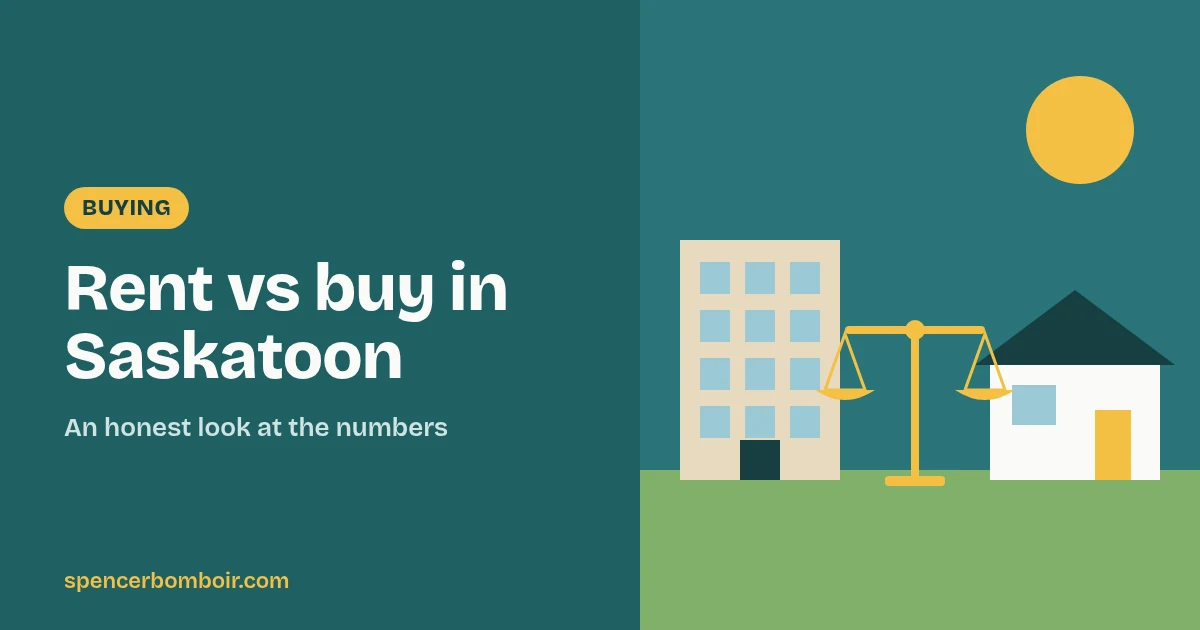
"Rent is just throwing money away." You've probably heard it. It's not totally true, and it's not totally false either.
Owning has costs you never get back too, like mortgage interest, property tax and repairs. The real question is which option costs you less over the time you plan to stay. Here's an honest look at renting vs buying in Saskatoon, with real numbers.
The short version
- If you might move in the next 2 or 3 years, renting usually comes out ahead. Buying and selling both cost money, and there isn't enough time to make it back.
- Around 5 years, it's close. Past 6 or 7 years, buying usually wins, as long as prices go up even a little.
- Either way, owning builds savings. Part of every mortgage payment goes toward your own home, and that's money you get back when you sell.
What rent costs in Saskatoon
The average asking rent in Saskatoon was about $1,340 a month for a one-bedroom and $1,620 for a two-bedroom in the second quarter of 2026, according to Statistics Canada. Rents here have been climbing too. The average two-bedroom asking rent was up 6% year over year in the third quarter of 2025, at a time when rents were falling in most of Canada's big cities.
When you rent, the landlord covers the big stuff: the roof, the furnace, property tax and the building's insurance. You get flexibility, and you can usually move with a couple months' notice.
What owning costs that you don't get back
A lot of people compare rent to a mortgage payment. That's not quite fair, because part of your mortgage payment is savings. The costs you actually lose as an owner are:
- Mortgage interest, the biggest one, especially in the early years
- Property tax and home insurance
- Repairs and maintenance, which are now on you
- Extra utilities, like heat and water, which are often included in rent
- Buying costs, like legal fees, land titles fees and PST on mortgage insurance
- Selling costs when you move on, mostly commission. Our post on what it costs to sell a house breaks these down.
- Mortgage insurance, if you put down less than 20%
On the other side, if your home goes up in value while you own it, that gain works in your favour.
Renting vs buying: the numbers
Here's a side-by-side for someone renting a two-bedroom at $1,620 a month, compared to buying a $300,000 starter home with 5% down. We've worked out the money each one costs you that you don't get back, on average per month, depending on how long you stay.
| If you stay... | Renting | Owning, prices flat | Owning, prices up 2% a year |
|---|---|---|---|
| 3 years | $1,694/mo | $2,687/mo | $2,200/mo |
| 5 years | $1,745/mo | $2,345/mo | $1,848/mo |
| 7 years | $1,798/mo | $2,197/mo | $1,689/mo |
| 10 years | $1,882/mo | $2,081/mo | $1,558/mo |
Lower is better. Renting assumes rent goes up 3% a year, plus tenant insurance. Owning assumes a $300,000 home, 5% down, a 4.5% five-year fixed rate held for the whole period, a 30-year mortgage with mortgage insurance, property tax, home insurance, repairs and extra utilities, buying and selling costs (with a 4% example commission), and the return you'd miss by not investing your down payment. Estimates only.
What the table is really telling you
Short stays favour renting
Buying and selling both cost money up front. If you're only in the home for two or three years, those costs get spread over too few months, and renting comes out cheaper.
Longer stays favour owning
Every year you stay, your buying and selling costs get spread thinner, your rent would have kept climbing, and more of your mortgage payment goes to principal instead of interest. With even modest price growth of 2% a year, owning comes out ahead at around the 6 year mark in this example. If prices stay completely flat, renting stays a little cheaper on paper, even at 10 years.
Even when renting wins on paper, owning builds savings
Here's roughly what the owner would walk away with after selling and paying off the mortgage:
| Cash in hand after selling | Prices flat | Prices up 2% a year |
|---|---|---|
| After 3 years | about $3,700 | about $21,300 |
| After 5 years | about $15,000 | about $44,800 |
| After 7 years | about $27,300 | about $69,900 |
| After 10 years | about $48,000 | about $110,700 |
After commission, legal fees and paying out the mortgage, with no penalty. Includes the original down payment.
A renter could end up in the same spot, but only if they invest the money they would have put into a down payment and higher monthly costs, every month, without dipping into it. That's harder than it sounds. A mortgage does the saving for you.
A 2% yearly rise is a modest example, not a promise. Prices can also go down.
It's not only about the money
A few things don't show up in a table:
Renting is great for flexibility. New job, new city, a relationship change, or still figuring out which neighbourhood you love. Renting keeps your options open.
Owning gives you control. No landlord, no surprise rent increase at renewal, and the freedom to paint, renovate, get a dog or put in a garden.
Owning comes with surprises. When the furnace goes in January, that's your bill. Keep an emergency fund, and get a good home inspection before you buy.
Questions to ask yourself
- Am I likely to stay in Saskatoon, and in roughly the same area, for 5 years or more?
- Is my job and income fairly stable?
- Do I have a down payment plus closing costs saved, with some left over for emergencies?
- Would I rather have flexibility, or control over my space?
If most of your answers point toward staying put for 5 years or more, buying is probably worth a serious look.
Ready to run your own numbers?
Every situation is different, so the best next step is plugging in your own rent, savings and income. Our "Can I afford to buy?" calculator takes about a minute, and our post on whether you can afford to buy in Saskatoon compares a condo and a small house side by side. If you're a first-time buyer, our first-time home buyer guide walks through every step.
If you'd like to talk it through, send us a note or book a quick call. We'll give you an honest answer, even if that answer is "keep renting for now."
This article is general information only and current as of November 2026. Rent figures are from Statistics Canada. The comparison uses simplified assumptions and estimates, not quotes, and your rate could change at renewal. It isn't financial advice. Talk to a lender or financial advisor about your own situation.