Should You Sell Your Home or Rent It Out? What Saskatoon Owners Should Know
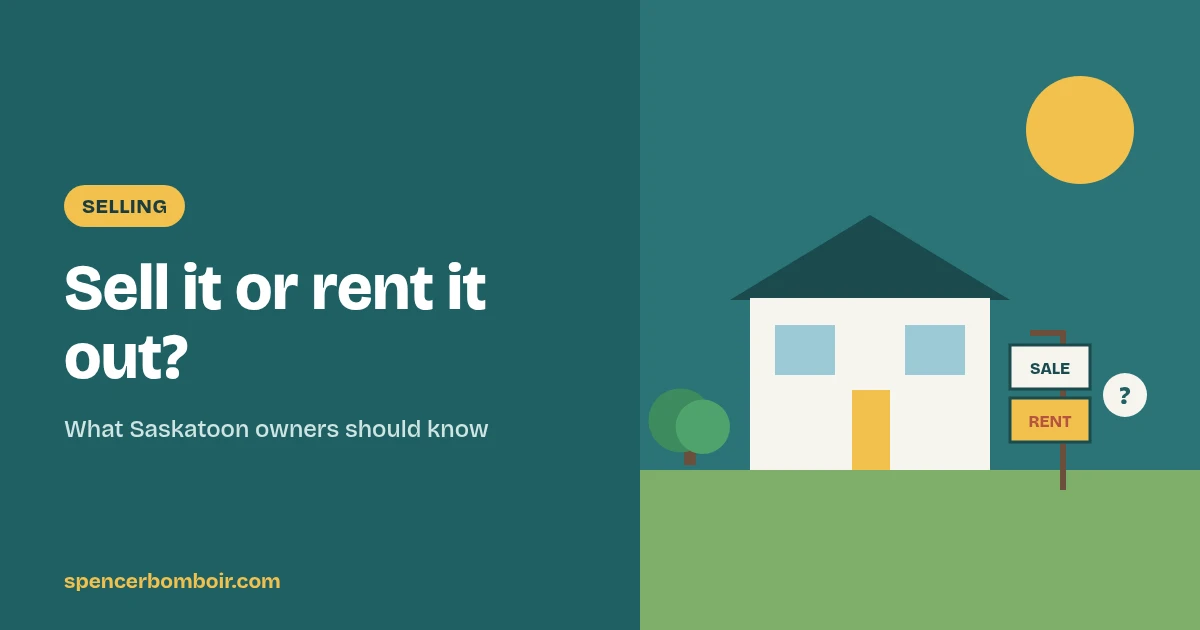
If you're moving, you might be wondering whether to sell your current home or keep it and rent it out. It's a fair question. Holding onto a home can build wealth over time, and rent can cover a lot of the costs. But being a landlord is real work, and it can change how much you can borrow for your next place.
There's no right answer for everyone. Here's how to think it through, a rough example with real-world numbers, and the tax and mortgage details that catch people off guard.
The short version
- Selling gives you your equity in cash, usually tax-free on your own home, and a clean break.
- Renting it out lets you keep the home and any future growth, but you take on a landlord's costs, risks and time.
- For a lot of homes, the rent only just covers the costs. The payoff comes from paying down the mortgage and the home going up in value over time.
- Talk to your lender and an accountant before you decide. The tax and mortgage rules make a big difference.
The case for selling
- Cash for your next home. Your equity can go toward your next down payment, which can mean a smaller mortgage.
- Usually no tax on the gain. If it's been your home the whole time you've owned it, the principal residence exemption generally means you don't pay tax on the increase in value.
- One mortgage, not two. It's simpler to qualify for your next home, and you're not carrying two properties if something goes sideways.
- No landlord work. No tenants, no repair calls, no empty months.
The case for renting it out
- You keep the asset. If the home goes up in value, that growth is still yours.
- Your tenant helps pay the mortgage. Every payment builds your equity, even if the rent only just covers the costs.
- You may keep a good rate. If you locked in a low rate, keeping that mortgage can be worth a lot, though you'll need to check with your lender (more on that below).
- Demand is there. According to CMHC's 2025 Rental Market Report, Saskatoon's rental vacancy rate was 3.3%, still below its 10-year average. Rented houses are a smaller market than apartments, but a well-kept house in a good spot usually rents.
Run the numbers first
Here's a rough example to show how the math works, not a promise of what you'll make. Say your house is worth $400,000, you owe $250,000 at 4.5% with 25 years left, and it would rent for about $2,200 a month:
| Monthly | Amount |
|---|---|
| Mortgage payment | $1,384 |
| Property tax (about 1.25% a year) | $417 |
| Landlord insurance | $150 |
| Repairs and upkeep (1% a year) | $333 |
| Total cost | $2,284 |
| Rent in (example) | $2,200 |
| What's left | About -$84 |
Rent, tax, insurance and repair figures are examples only. Check what similar homes near yours actually rent for, and get real quotes.
That looks like a loss, but about $450 of that mortgage payment goes to paying down your loan each month in the first year, so you're still building equity. On the other hand, this example doesn't include empty months, a property manager, utilities you might cover, or income tax on any profit. Change any one of those numbers and the picture can swing either way.
The homes where renting works best are usually ones with a low mortgage balance, a legal suite, or rent that's high for what the home is worth. If you'd need to borrow against the home to buy your next one, the numbers get tighter fast.
Taxes to know about
Rental income is taxed. Rent is added to your income each year, minus allowable expenses like mortgage interest, property tax, insurance and repairs.
Changing your home to a rental counts as selling it, for tax purposes. When you start renting out your whole home, the CRA treats it as if you sold it at fair market value that day. Because it was your home up to then, there's usually no tax on the gain so far. But any growth after that can be taxable when you eventually sell.
The 45(2) election. You can file an election with your tax return to delay that change. It can let you keep calling the home your principal residence for up to four more years while it's rented. There are catches: you generally can't claim depreciation on the home while the election is in place, and your family can only have one principal residence per year, so it can compete with your new home.
Capital gains when you sell. Under the current rules, half of a taxable capital gain is added to your income. Depreciation you've claimed can also be taxed back when you sell.
This is the part to get advice on. An accountant can tell you whether the election makes sense for you before you sign a lease.
Your mortgage and your next home
Tell your lender. Most mortgages on a home you live in assume you live in it. Your lender may need to change the terms, or the rate, once it's a rental.
Qualifying for two homes. You'll need to qualify for your new mortgage while still carrying the old one. Lenders usually only count part of the rent as income, so you may qualify for less than you'd expect. A new home you'll live in can often be bought with as little as 5% down, but if your equity is staying in the old home, that down payment has to come from somewhere else.
Borrowing against the old home. Some people use a home equity line of credit on the old place for their next down payment. That adds another payment, and it changes the rental math above.
Talk to your lender or a mortgage broker before you decide. It's the fastest way to find out whether keeping the home is even an option.
Being a landlord
- Switch your insurance. A rental needs a landlord policy, not a regular home policy.
- Know the rules. Saskatchewan's Office of Residential Tenancies sets the rules for leases, deposits, rent increases and ending a tenancy. Read up before your first tenant moves in.
- Plan for turnover. Budget for a month or two without rent at some point, plus cleaning and repairs between tenants.
- Decide who handles it. If it isn't you, a property manager will usually take a percentage of the rent.
- Check condo bylaws. If it's a condo, some buildings limit rentals. Read the bylaws first.
A few questions to help you decide
- Do you need your equity for your next down payment?
- Would the rent cover the costs, including empty months and repairs?
- Can you qualify for your next home while carrying this one?
- Do you want to be a landlord, or pay someone to do it?
- Are you keeping it as a long-term investment, or just waiting for a better time to sell?
If you're mostly hoping to wait out the market, be honest with yourself about that. Our post on the best time to sell in Saskatoon might help. And if you're selling one home and buying another, our guide to buying and selling at the same time covers the timing.
Want two numbers to compare?
We can give you an honest idea of what your home would sell for, and what similar homes nearby are renting for, so you can run both sides with real numbers. Our guide to what it costs to sell covers the selling side, and our post on investing on Saskatoon's west side goes deeper on rentals and suites.
Send us a note or book a quick call. No pressure either way.
This article is general information only and current as of November 2026. It isn't financial, tax or legal advice. The example uses assumed rates, rents and costs, and the vacancy figure is from CMHC's 2025 Rental Market Report. Tax rules, lender policies and tenancy rules change and depend on your situation, so talk to an accountant, your lender and a lawyer before making a decision.